Showing posts with label foraging. Show all posts

Monday, 11 September 2017

Making damson jam: 'jamson'


Under the heading of preserves, I've made pickled veg, chutney and clementine curd, but never jam.
On a walk a couple of days ago, while out walking with a friend, I spotted an amazing array of plum (or maybe damson) trees bordering the footpath. We'd already enjoyed apples and blackberries along the way. 'I'm coming back with a bowl,' I said. And I did. 

I was thinking of making damson gin (I like to make drinks from foraged finds) but my partner surprised me by suggesting jam, adding that he'd made it before. He couldn't remember when, or what type, but he'd definitely done it.

So I dug out my ancient Delia Smith Complete Cookery Course and found a recipe, conveniently for around the weight of damsons we had, about 2kg.

We heated the sugar in the oven, as directed, then into the pan (not a special preserving pan, just a big saucepan) with the sugar and fruit and it was soon boiling away.

The bit I was waiting for was the wrinkle test, when you drop a blob of your soon-to-be-jam on a cold plate and push it with your finger to see if it wrinkles. We did this about five times – 'another five minutes' – before it was set.

What went wrong
I forgot to remove the stones, so need to put warning labels on some of the jars. Before I filled the biggest jar, I put the remaining jam through a sieve, picked out the stones, then scraped the mush into the jar.




SaveSave

Monday, 20 October 2014

How to make sloe gin

Sloes are members of the plum family and grow from October through to November - they are delicious infused in gin, creating a sweet, fruity drink with a bitter edge. Make it now and drink it or give it as a gift at Christmas.

• 200g sloes
• 400ml gin
• 100g granulated sugar

Prick the sloes’ skins. You can do this by piercing each one individually, or just pop them in the freezer for a couple of days.

Push the pierced sloes (frozen or not) into a screw-top bottle (wide-necked is easier, but the bottle you’ve taken the gin from may be handier). Pour in the sugar and add the gin.
Seal tightly, shake to combine and store in a cool, dark place.

Give the bottle a shake every day until all the sugar has dissolved. It’s ready to drink in about three weeks, but the sloe flavour becomes more pronounced the longer you leave it.

Sunday, 7 October 2012

Make a rough-and-ready autumn leaf wreath

This is simply some twigs with reddish leaves, picked up while out foraging for wood for the stove.

How to make a leaf wreath
Start with a long twig, bend into a rough circle, then weave in another twig. Try to get the leaves appearing evenly around the ring. Tie twigs together as necessary. Hang on door.
As you can see, mine is very rough-and-ready indeed.
In the past, I've made autumn wreaths with different foliage types but I think the single-species version looks good, too.

Monday, 26 March 2012

Wonderful ways with weeds

Now the clocks have gone forward we have an hour more light, and what better way to spend it than weeding? (Yeah, right!)

Ripping the weeds out now while they're young and tender means they're less likely to take over, robbing your poor plants of nutrients. So what better method of destruction than using the weed to feed yourself or your plants?

The two I put to good use at the weekend were nettles and comfrey. When they're young and tender, nettles make a lovely soup. Pick the smaller top leaves (you'll need to wear gloves; the little ones can be vicious too). Avoid ones that are likely to have been watered by dogs, and check for greenfly; they're not easy to wash or pick off.

And for the soup: gently fry a chopped onion in oil or butter, add a couple of small diced potatoes, a couple of handfuls of nettle leaves (discard stalks, which can be tough), and some stock. Bring to the boil, then simmer until potato is soft - by which time the nettles will have lost their sting. Blend until smooth, then serve, for a deliciously fresh-tasting soup.

Comfrey makes a great liquid feed for your plants. Pick the bigger leaves lower down on the plant, put into a container with a lid, weighted down by bricks or plant pots. As they decompose, the leaves produce a seriously stinky liquid (you'll be glad it's under a lid) which makes a great plant feed, as it's rich in nitrogen, phosphorus and potassium plus other trace minerals. Dilute it 1:15 and water your plants with it.

Wednesday, 11 May 2011

How to make elderflower champagne - free fizz!

If you like elderflower cordial, you'll love elderflower 'champagne'. What's not to love: it's (almost) free fizz - and I'm a big fizz fan.

How to make elderflower champagne 
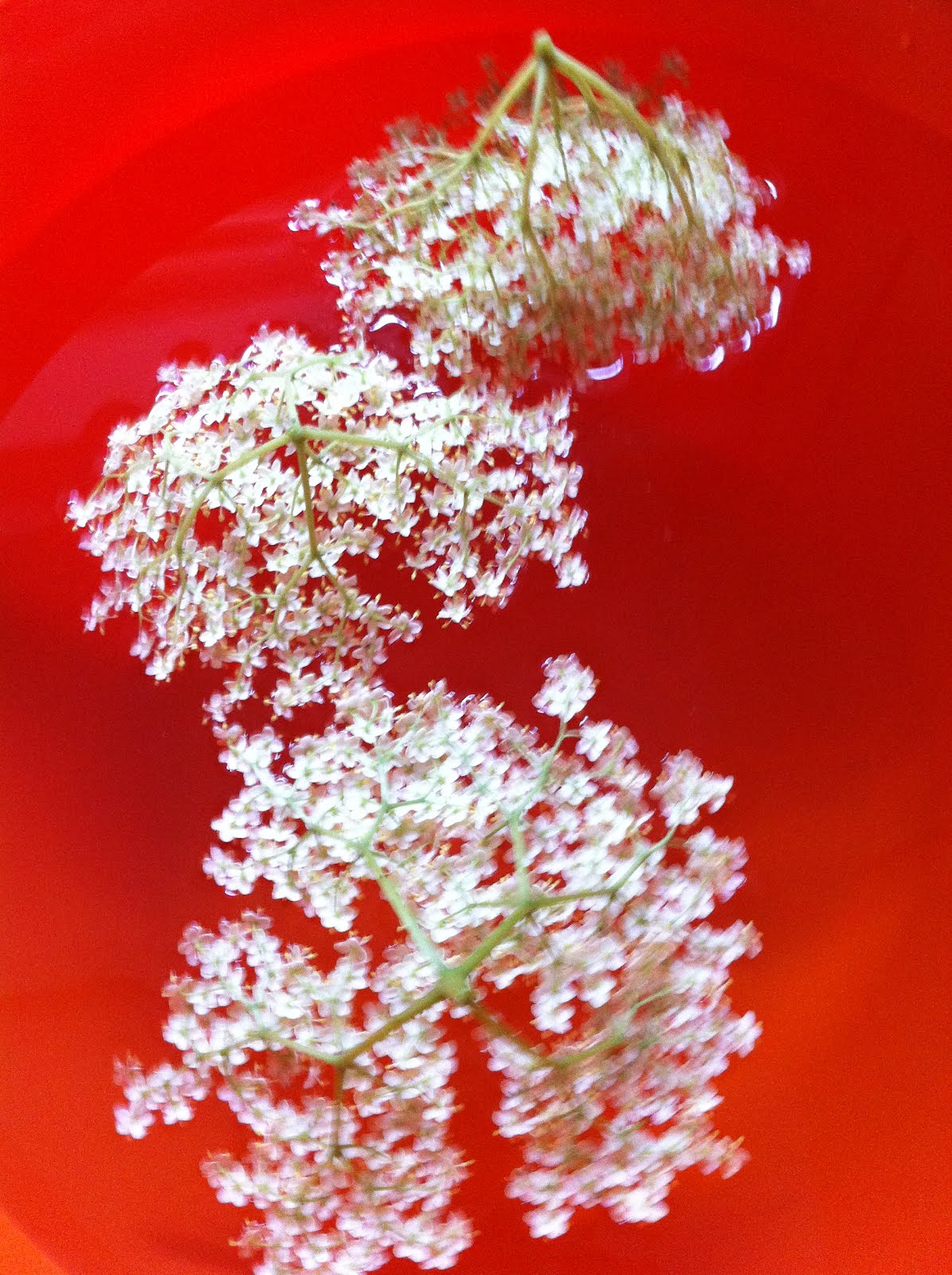
Pick five or six elderflower heads, preferably on a sunny day. Choose elder trees that aren't on a busy road, and avoid flowers lower down that may be contaminated by the urine of dogs, foxes, or even humans... Pick off any insects etc before using. Don't run the flowers under the tap or you'll wash the natural yeasts off.
Pour 20 litres of cold water into a plastic bucket of at least 25 litres capacity. Stir in 1kg of ordinary sugar until dissolved. Drop in the flower heads and stir to submerge. Add the zest and juice of two lemons and 4tbsp white wine vinegar. Stir to mix, then lay a clean teatowel over the bucket and leave for 24 hrs, stirring occasionally.
After 24 hours, pour the liquid through a sieve to remove the detritus, then pour though a funnel into a collection of two-litre plastic bottles (bought for 17p each, full of water, from a well-known supermarket). Leave the bottles for at least two weeks. They'll become more rigid as the fermenting causes carbon dioxide to build up, and you can unscrew the top a little (carefully!) to release some of the pressure.
After two weeks you can drink it, and it'll be around 3% alcohol, depending on how your fermentation went. It slips down very easily, and is particularly delicious with gin - probably best not to drive to be on the safe side...

Saturday, 30 October 2010

A wreath is not just for Christmas

Sadly, our trip to New England last month was slightly too early for the magnificent autumn colour show, but there were hints of what was to come... like this leaf I picked up by Lake Champlain in Burlington, Vermont (where the town was papered with posters advertising a wool show celebrating all aspects of the material).
After we came home autumn set in here, and on a walk with friends we all foraged for autumn leaves and berries, and I made a wreath for the door - much admired by the neighbours and the postwoman. As you can see I used berried ivy, old man's beard, hops and autumn leaves, plus some evergreen leaves from my garden. To make it, I used a woven twig wreath as a base, which normally hangs on the wall indoors, and wove in my greenery (and goldery and orangery). As there was no moisture-retaining material like Oasis the wreath didn't last long...
...but that didn't matter because a couple of weeks later the weather suddenly got cold overnight and the little maple tree spat all its leaves on to the ground at once. That vivid red is too good just to sweep up and throw in the compost heap, so I made another wreath, using the same twig wreath base. This one only lasted a couple of days, but it was worth it!